The Keys Are in the Books
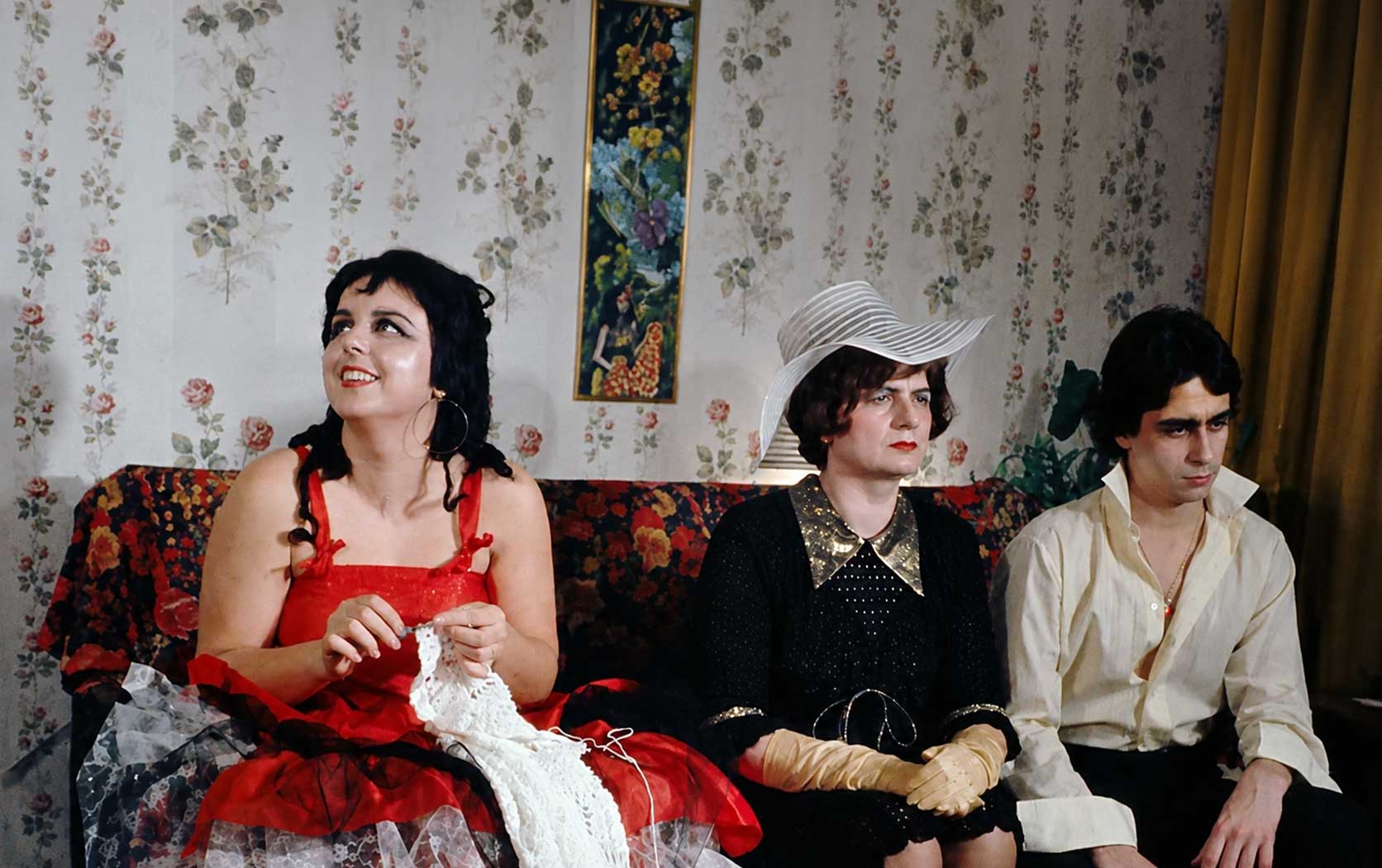
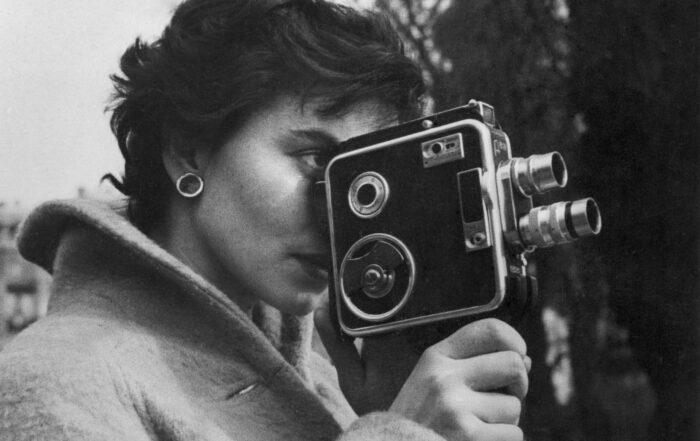
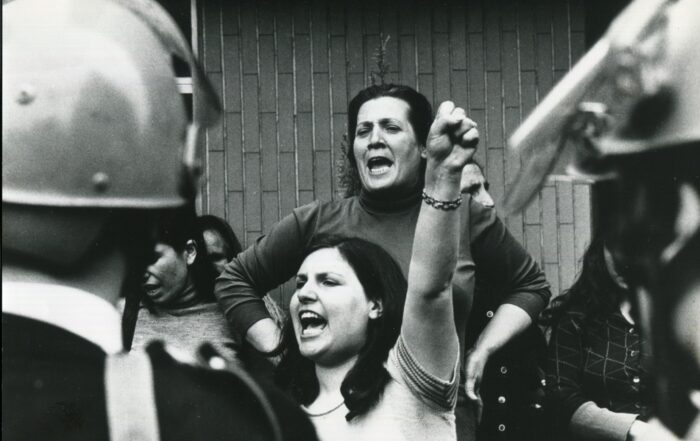
Elfi Mikesch has spent six decades creating images. In preparation for our conversation, she put together an outstanding list of books that have shaped her.
Berlin, Schöneberg. You come up the stairs of an old Berlin apartment house and the door opens. Elfi Mikesch gives you a warm welcome as does the room around her. Leaning against the wall, standing directly on the floor, a large black/white photograph: a woman looking out at you. She does not defer. You are in her room, and she has been waiting.
In the study, books are everywhere. On the table, on the chairs, on the shelves. Photographs and paintings fill the walls. Some are by Mikesch, some by her partner Lilly Grote, some by friends: Rosa von Praunheim and Werner Schroeter, the two men with whom she shared so much of her working life.
For our conversation, she has prepared a pile of books. Pages are marked, passages underlined, quotations highlighted. She has also made notes on her computer, which she consults in the middle of talking. “I’ve made a note here,” she says. “I’m just saying it out loud so I remember the exact wording.”
At eighty-six, after sixty years of making images, Elfi Mikesch meets the world with the curiosity, openness, and energy of someone discovering it for the first time. The books are not there to demonstrate what she has read. They are working tools. You look at the pictures differently after hearing Mikesch talk about the books and their authors. Perhaps that is what the books are for. Not to explain the pictures, but to give you another way into them.
For me personally, the bag of books she had prepared for me under her table, were an extraordinary reading list, which we have the honor to share today: John Berger, Hannah Arendt, Simone Weil, John Cage, Maya Deren, Helke Sander, Gabriele von Arnim, Roland Barthes, and Susan Sontag. Philosophy, photography, film, feminism, spirituality, beauty. Less a canon than a collection of things that have caught her attention, and held it.
Maya Deren – Divine Horsemen: The Living Gods of Haiti Deren was one of Mikesch’s very first “keys.” Mikesch recalls a time when photography still felt like a closed, rigid “black box.” Discovering Deren’s films opened that box. Deren was both mysterious and concrete, physically present in her own work. For Mikesch, Deren proved that body language and film language could become one. She keeps this book close, still admiring Deren precisely because she has never stopped being a fascinating riddle.
John Berger – Das Leben der Bilder (The Life of Images) This is the book she is currently reading. Mikesch praises Berger for finding a precise language for photography and art. He manages to bring an artwork closer and analyze it while simultaneously allowing the reader to discover it anew. He provides the words for the very images Mikesch has spent her life creating.
Hannah Arendt – Macht und Gewalt (On Violence) Mikesch reads Arendt with profound seriousness. She is deeply influenced by Arendt’s existential and political questioning, particularly highlighting the fundamental question: “Who is speaking?” For a filmmaker, understanding the source and authority of the narrative voice is crucial.
John Cage – Empty Mind Holding this book, Mikesch expresses pure joy, noting how much Cage loved to laugh. She draws on his concepts of “furniture music” (Möbelmusik), the vibrations of a room, and the willingness to embrace chaos. Cage’s work helps her articulate the invisible, vibrating energy present in a physical space.
Helke Sander – Texte aus »Frauen und Film« Where politics and cinema intersect, Sander is indispensable. Mikesch honors her as a courageous political filmmaker who puts things exactly on point. Sander founded the journal Frauen und Film in 1974, at a time when society had barely begun to ask who was even permitted to hold a camera. Mikesch notes that Sander forces everyone—not just women, but all of society—to pay attention.
Simone Weil – Krieg und Gewalt (War and Violence) Pulled directly from her pile of books during the conversation, this essay collection is mentioned with immense, repeated emphasis. It grounds her theoretical reading in the harsh, concrete realities of human conflict and societal trauma.
Gabriele von Arnim – Der Trost der Schönheit (The Consolation of Beauty) Sitting alongside heavy texts on war, violence, and politics, this book points in an entirely different direction. It represents the vital, parallel search for solace, aesthetics, and the comforting power of beauty amidst the chaos.
Roland Barthes – Die helle Kammer (Camera Lucida) Mikesch explicitly connects this seminal book on photography to her own tactile, almost magical early experiences working in the darkroom. For her, Barthes perfectly captures the essence of that environment: the interplay of red light, green light, and darkness. The book helps frame her transition from viewing photography as a static medium to understanding how an image can capture a living “vibration in a room.”
Susan Sontag – Essays on Photography and Film Sontag serves as a definitive philosophical anchor for Mikesch regarding how she understands her chosen medium. She specifically recites a thought from Sontag to clearly differentiate two distinct art forms: she notes that while theater cultivates the artificial, film grants rights to a highly physical reality. This philosophy perfectly mirrors her own lifelong approach to capturing the raw, tangible presence of her subjects through the lens.
Anna Ramskogler-Witt
Doxumentale
Biography
Anna, co-founder and Artistic Director of Dokumentale, loves good documentaries and non-fiction books as a source of knowledge and entertainment.