Making films regardless
The programming for Another Story introduces us to female filmmakers from across Europe and their works in a wide range of styles, drawn from diverse backgrounds and origins, We realise that these filmmakers often have unique, individual and personal profiles, each of great richness. In short: there’s no point in putting them into boxes, and certainly not into the ‘female filmmakers’ box.
However, there is one constant that emerges from our research: their careers have been marked by ups and downs; they have proved to be multi-talented – most often out of necessity – and their filmographies are sometimes limited to just one or two films. These usually present strong artistic and conceptual elements and come along before or after a detour or a change of career.
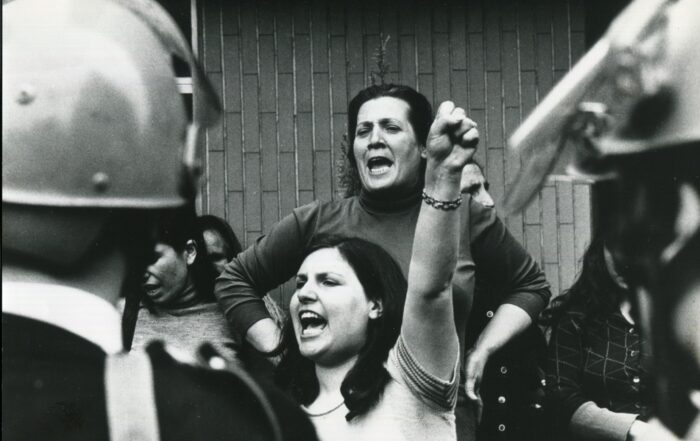
Yvonne Scholten (born in 1943), a Dutch journalist who lived in Italy for fifteen years, directed just one film, Donna: Women in Revolt (1980), before continuing her career as a television editor and turning her attention to other subjects (notably the Spanish Civil War). Donna bears witness to the women’s contribution to the history of Italy from the 1940s to the 1980s. The film, restored in 2023 by the Eye Filmmuseum in Amsterdam, offers a deeper understanding of the role of women in the country, and resonates with the feminist claims of today.
Serap Berrakkarasu, a director of Turkish origin (born in 1962) who lives in Lübeck, has directed two films: Töchter zweier Welten (Daughters of Two Worlds, 1991) and Ekmek Parasi – Geld fürs Brot (Money for Bread, 1994), the latter shot by cinematographer Gisela Tuchtenhagen. Daughters tells the story of the impossible dialogue between a mother, a Turkish woman who immigrated in Germany, and her daughter, who wants to break free from the overly conservative constraints of her culture of origin. The film premiered at the Berlin Film Festival (in the Forum section) and was co-funded by the German television channel NDR. After that, Serap Berrakkarasu never made any more films.
Lorenza Mazzetti (1927–2020) was one of the founders of the Free Cinema movement in England in 1956, alongside Lindsay Anderson, Tony Richardson and Karel Reisz. She never received the same recognition as her co-founders, despite directing five films (including Together in 1956, restored in 2023) and writing six books (including Il cielo cade, a major hit in Italy in 1962); she led a creative life spanning writing and puppet theatre, yet she has been omitted from film history in favour of the three male directors. Together, which received a Special Mention for experimental film at the 1956 Cannes Film Festival, is a poetic gem featuring a deaf-mute duo wandering through London’s East End in the immediate post-war period, annoyed by idle children.
From the same generation, French director Yannick Bellon (1924-2019) made her first film, Goémons, a documentary that won the International Grand Prize for Best Documentary at the Venice Biennale in 1954. She then had to wait almost 20 years to direct her first feature-length fiction film, Quelque part quelqu’un (1972). In the meantime, she continued to work and directed more than fifteen short films and features for the public television. To make her second film, for she set up her own production company, Les Films de l’Equinoxe. Renowned composer George Delerue composed the film’s score, and even went so far as to cover the costs of the film’s orchestra and choir in support of Bellon. Of course, Yannick Bellon had continued to work in the meantime, directing more than fifteen short films and features for the public television.
Marlies Graf Dätwiller (1943–2020), a Swiss filmmaker and co-founder of Filmkollektiv Zürich, who trained as a goldsmith, directed her first film, Behinderte Liebe (Disabled Love), in 1980, which dealt explicitly with the sexuality of people with disabilities. She continued her career sporadically with films addressing social issues, though these did not achieve the same level of recognition as her debut film.
Vibeke Lokkeberg (born in 1945), a Norwegian film director, directed four films in the 1970s, then went through a difficult period during which she successfully reinvented herself as a prolific writer before returning to filmmaking in 2010. In 2019, fifty years on, rthe aw footage was rediscovered from her shooting at the 1973 Berlin International Film Seminar organised by Claudia von Alemann and Helke Sander, and decided to edit this material, which had been set aside by Norwegian television at the time. The result was The Long Road to the Director’s Chair, which was invited to the Berlinale in 2025.
These give examples of the non-linear journeys that characterise many women directors’ careers: women artists had to work as journalists, writers or editors, in the field of documentary and/or fiction, making short films and feature-length films, with or without television. These female directors are attuned to the world around them; they take measure of societal change and bear witness through their medium, cinema. They highlight women’s contributions at every stage of history, even as they recognise that women have been sidelined from the narrative. Another Story brings them back to our attention and works to broaden our horizons so that these films can continue to be shown and enjoyed long into the future.
Charlotte Ducos
Loreley Films