Two Critics, One Film
Written during the Another Story Critics Lab at Doxumentale ’26, these reviews reveal how a single film can inspire radically different interpretations.
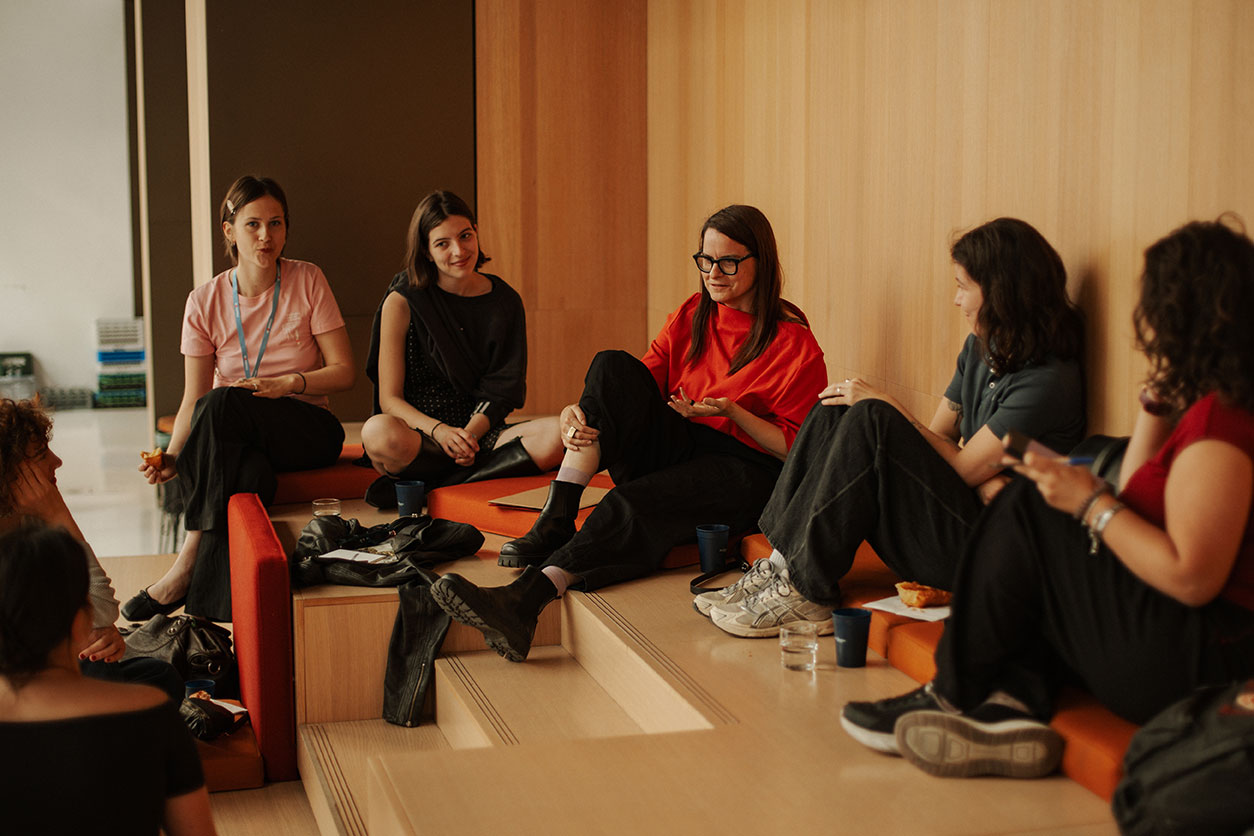
As part of Doxumentale ’26, the Another Story Critics Lab gathered seven emerging film critics for an intensive workshop under the guidance of Berlin-based New Zealand film critic, journalist and programmer Carmen Gray. Combining daily writing exercises with editorial discussions and individual mentoring, the Lab provided a space for participants to refine their critical practice. With a particular emphasis on films by women and women’s representation in cinema, the Lab encouraged participants to develop their own critical voices and approaches to film criticism. The two reviews that follow, both responding to Elfi Mikesch’s I Often Think of Hawaii, demonstrate how the same film can give rise to strikingly different interpretations, reflecting the diversity of contemporary critical practice.
Review: I Often Think of Hawaii
by Elina Vlasova
Your mother leaves for work on an ordinary morning. You wake up, almost sixteen years old, and suddenly everything you believed in yesterday feels distant and somehow wrong.
For me, this is the emotional starting point of I Often Think of Hawaii (1978), Elfi Mikesch’s intimate portrait of a teenage girl and her family as they move through the routines of everyday life while dreaming of somewhere far beyond it.
The film follows Carmen, who lives with her mother Ruth and brother Tito in Gropiusstadt, a vast postwar housing estate in 1970s West Berlin. Designed by Bauhaus founder Walter Gropius as a model of modern urban living, the development later became associated with social deprivation and isolation. This setting is crucial to Mikesch’s portrait of a working-class family searching for escape. The image of Gropiusstadt was later shaped by Christiane F.‘s Wir Kinder vom Bahnhof Zoo (1978), which made it almost synonymous with the social struggles of West Berlin.
From the very first moments of I Often Think of Hawaii, we find ourselves in conversation with Carmen. One of the opening scenes shows her riding a yellow U-Bahn train through Kreuzberg, and its interior carries a strange sense of nostalgia. Watching it, I was reminded of my own memories from adolescence: the unexpected conversations with classmates you had barely noticed before, simply because you happened to take the same train home. Randomly talking about life, sharing thoughts that would never come up in a less intimate setting. This is how Carmen feels throughout the film. We start entering her world even though she is very selective with her words.
I Often Think of Hawaii is unmistakably a coming-of-age story because we witness Carmen in the process of becoming someone. She spends her days doing ordinary things: washing dishes, wandering around the apartment, dressing up, and trying on different identities. Yet her main emotion that feels familiar is this mixture of boredom and longing. Carmen’s boredom is not the boredom of inactivity. It comes from being suspended between who she was and who she is about to become. She has no clear understanding of the future, no defined image of herself, and she often responds with rejection. Without explicitly saying so, she rejects her mother, her brother, and her neighborhood. The only thing she does not reject is the image of her absent father. Perhaps she cannot reject him precisely because he is not part of her reality.
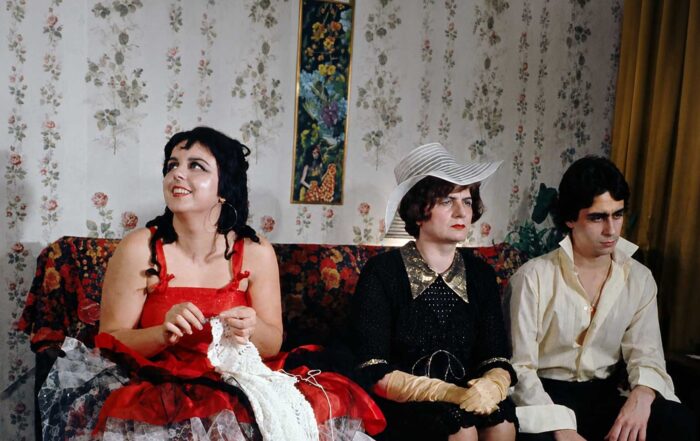
Dressing up is Carmen’s preferred form of escape. Throughout I Often Think of Hawaii, she appears in vivid reds and yellows, experimenting with outfits, poses, and identities. Makeup becomes a performance for both Carmen and her mother Ruth. Applied in thick, exaggerated lines that deliberately exceed their contours, it turns the face into a visible yet vulnerable canvas. If Ruth’s appearance reflects uncertainty about who she is and what remains ahead of her, Carmen’s stylization feels like an act of resistance against the monotony of everyday life.
Structured around the days of the week, Elfi Mikesch’s debut feature unfolds according to the rhythms of ordinary existence. A slow, almost monotone voice-over accompanies many scenes, offering brief, poetic observations that reveal the thoughts of either Carmen or Ruth. Listening to it feels like overhearing an inner monologue; reflective, melancholic, and unexpectedly perceptive. The apartment mirrors this emotional landscape. Patterned wallpaper, brightly colored crockery, and decorative details evoke the familiar visual language of a 1970s working-class household. Yet these interiors never feel entirely comforting. Ruth, who works as a cleaner, moves through them with quiet exhaustion. Abandoned years earlier by the father of her children, a Puerto Rican soldier, she seems trapped between work, loneliness, and thoughts of what her life might have been. The film captures a painful truth: when your mother is lonely, you often become lonelier yourself. The absent father remains a powerful presence. All that survives of him are some postcards and a collection of Hawaiian records. From those fragments, an entire fantasy about Hawaii emerges. It becomes less a real destination than a shared dream image onto which the family projects its hopes, disappointments, and desires.
One of the earliest female voices associated with New German Cinema, Mikesch approaches her characters with gentleness and sensitivity. Blending documentary observation with dreamy fiction, she creates a world that feels both strange and intimate. Watching the film, I was reminded of Helga Reidemeister’s Von wegen Schicksal (1979), another portrait of working-class life in a West Berlin housing estate, released in almost the same year. Nearly fifty years later, I Often Think of Hawaii remains startlingly modern. Recently restored by the Deutsche Kinemathek and screened in Berlinale retrospectives, it still carries an emotional precision that feels universally relatable across time.
Review: I Often Think of Hawaii
By Jovana Dinic
At first glance, a title like I Often Think of Hawaii suggests a tropical escape, making the film’s focus on repetitive mundane chores like washing the dishes feel completely out of place. Yet, Elfi Mikesch’s docufictional feature shows us that for its protagonist, the gray monotony of daily life is closely tied to fantasy. Premiering back in 1978 at the Rotterdam Film Festival, the film was restored in 2018 thanks to the Deutsche Kinemathek, after which it was screened again at the Berlinale. This year, it was part of Doxumentale’s “Female Lens” selection.
I Often Think of Hawaii is an experimental documentary film that depicts the life of sixteen-year-old Carmen (Carmen Rossol), who lives with her mother (Ruth Rossol) and brother (Tito Rossol) in the suburbs of Berlin. Her father, a Puerto Rican soldier, abandoned the family long ago, and they now lead a quiet, predictable, and monotonous life. The film strings together various scenes from Carmen’s life while we hear her voiceover narration off-screen, resembling diary entries. Dialogue is rare and mostly consists of arguments with her mother, serving to illustrate the fractured relationships within the family.
Repetition is woven into the film in multiple ways – over and over we see a shot of the mother leaving the house at 5am to go to work, we find Carmen with rubber gloves on washing the same dishes again, and we listen once again to her monotonous recitation of the same poem. Gray depictions of Berlin’s monolithic architecture alternate with a multitude of identical windows looking out onto bleak streets – not once in the film do we see sunlight – which is, in short, a reflection of Carmen’s life. When the family moved, she was left without the only friend she had.
Long before Haneke’s The Seventh Continent, Mikesch builds a similar sense of claustrophobia stemming from a meaningless daily routine that searches for its antithesis. In this case, imagination becomes the primary form of resistance against everyday life. In her small room, waiting for another day to pass, Carmen dreams of one day becoming a dancer. Wearing striking makeup, an extravagant dress, and holding a fan in her hand, she dances in her room, fantasizing about the vast beaches of Hawaii and sunsets. Within the world she is forced to live in, she builds her own microcosm. Her mother and brother are not a part of it – the camera clearly confirms this: we are jolted out of Carmen’s black-and-white fiction by her mother opening the door, bringing us back to the colored image of reality; and while we see the brother in the frame playing the violin, what we actually hear over it is Hawaiian music.
The film leaves us to answer for ourselves whether dreaming of Hawaii is pure escapism and Hawaiian music merely an aesthetic tool, or if it is a matter of a deeper need for meaning and an exploration of one’s own origins. Carmen tells us that her mother wanted to move to America, but all she managed to do was marry Robert, a Puerto Rican who quickly abandoned her. “He would have shown me the world,” repeats the mother, statically positioned on a chair. Emotions are treated in a dual manner in the film – although they constantly filter through, from boredom to the fear of loneliness and longing of love, they are often not made overly explicit; a distance characteristic of New German Cinema is maintained.
It is easy to lose sight of the fact that I Often Think of Hawaii is a documentary film. Similarly to the life of the protagonist herself, the film plays with the boundary between reality and imagination. While she comments on how meaningless her mother’s job as a cleaner is to her, we see Carmen in a carefully styled, symmetrical shot, expressionlessly wiping windows wearing pink rubber gloves. Sometimes, instead of narration, we hear her reciting emotional verses, and the whole family, in disguise, even performs a poem by Prevert.
Carmen’s confessions suggest an intimate, almost diary-like relationship between the protagonist and the director Elfi Mikesch, thanks to which the film blurs the stable line between the observed and the staged. In this sense, I Often Think of Hawaii does not ask the viewer to choose between reality and fiction, but rather to remain in a space where both are simultaneously possible. This space does not belong to Carmen alone; it serves as an example of contemporary experience – a kind of archetype in which the individual struggles with the meaninglessness and repetitiveness of daily life, trying to find their place in the world. That is where the film achieves its universality: not in the uniqueness of a single biography, but in a form that captures the very way life can be viewed and understood today – as something that is constantly mediated, questioned, and reimagined as we observe it.